Showing posts with label grow your own. Show all posts

Sunday, 5 June 2011

Cordon tomatoes - an experiment

I've always muddled along with tomatoes, never really focusing enough on pinching out and stopping, and ending up in August with an inadequate support for laden plants. This year I'll do better by my plants!
I saw a programme on heritage varieties growing in the Victorian glasshouses at Audley End where the kitchen garden is managed by Garden Organic. Inspired by seeing cordon tomatoes growing up strings, I've decided to try something similar at the allotment.
To make: timber offered by an allotment neighbour and a lady whose dustbins in Putney I was passing, an extra spike sleeve from the hardware shop in the high street for one of the uprights,  baler twine I've had for years, some odd nails and screws. Online I came across a video by an American woman who used a 'spousal unit' in construction. I substituted an etiolated nineteen year old for knocking in of posts and this worked fine.
I think there may be a reason why you don't see this method for out of doors. Maybe wind jars the stems.  Anyway, looking forward to lovely tall plants, allowed to grow as indeterminatley long as a London summer allows.

frame and bind-a-twine
string wound around plant

bow knot that can be adjusted

pegged to ground (pinch out side shoots!)


I have 8 varieties:
Tigrella - Mr Stripey in the US, apparently
Ryder's Midday Sun - Garden Organic Heritage Variety, seeds shared by Master Gardener Claire Benson - blog Claire's Crops
F1 Tomatoberry - heart shaped and really rather expensive seeds
Costoluto Fiorentino - bulging beefy type
Golden Sunrise - seedlings shared with the latest cohort of South London Master Gardeners at their training in April to practise pricking out
Roma - a bush, ie determinate, plum variety
Sweet Olive - a 'grape' tomato, also determinate
Gardener's Delight - classic 'ultimate cherry tomato'
Elsewhere in pots I'm growing Minibel and Tumbling Tom Red.

I have some spare plants if you're local and quick off the mark.  I will have lots of toms to give away too (fingers crossed!)

Sunday, 22 May 2011

Bolting


It was the driest April since records began and in London and the southeast the dry has continued into May. This is very serious for farmers (and us all, as food prices will go up further still) and my bolting spinach is hardly a big deal by comparison.  Bolting is a plant's response to dryness or a sudden change in temperature.  The plant aims to flower and set seed  before it dies.  A flowering spike shoots up, often in the space of a couple of days, in a pre-programmed last ditch response to drought. Spinach is prone to bolting, even if you think you're watering carefully, and it's worth looking for bolt-resistant varieties. Typically you sow in early spring and again from August to avoid the dry season.  Anyway, I've lost this lovely variety (from a seed swap, no label, forgotton the name) which was pretty, unusual with its sagittate leaves and tasty.
Nothing to do but take the remaining leaves and toss with a dressing and baby broad beans.  I have sown Florence fennel in its place - also a notorious bolter - but May/June is the time to sow in this case to as cold is the bigger trigger to bolting.

Sunday, 8 May 2011

Early May trug shots - pink and green freshness

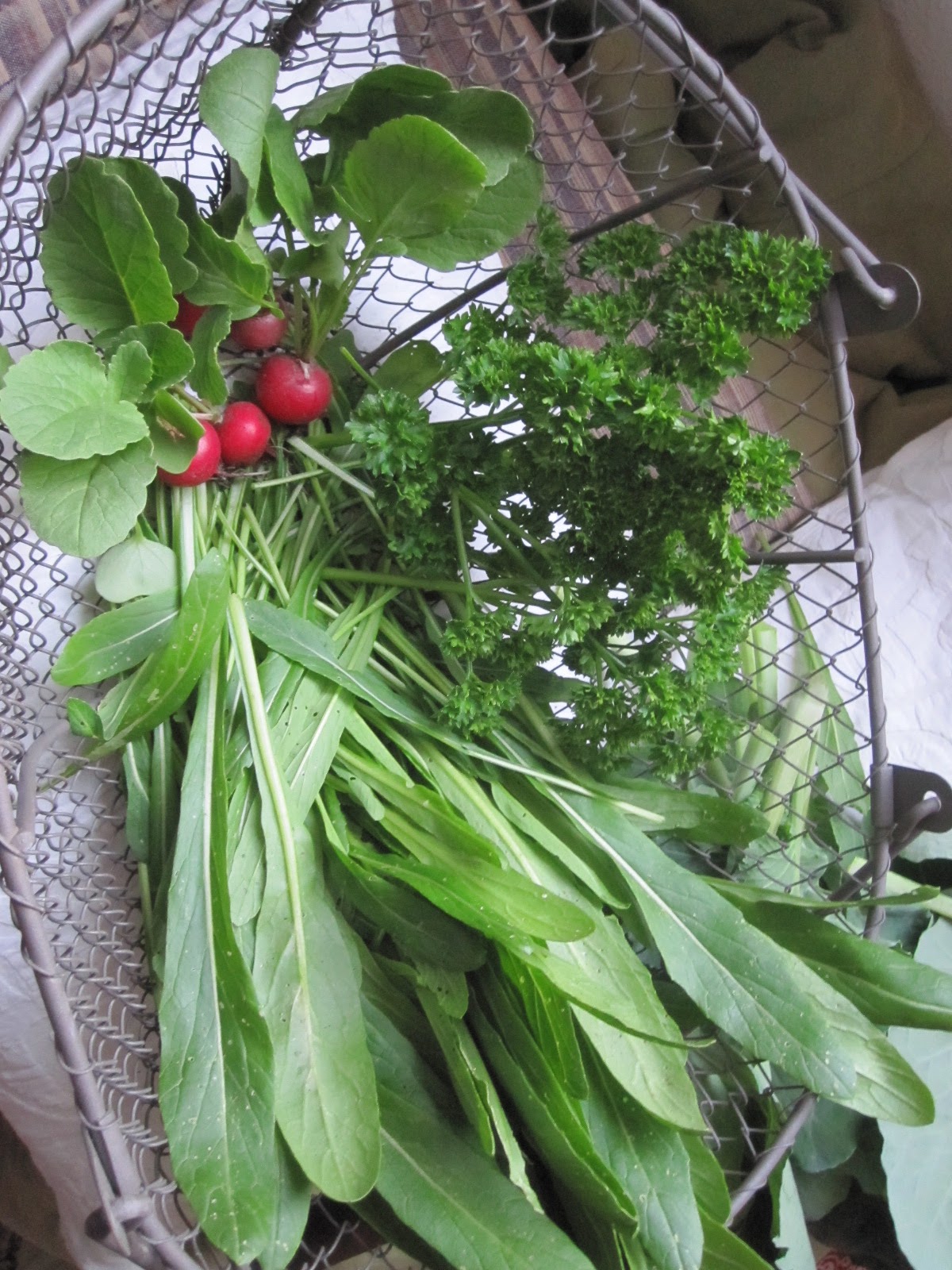
mibuna, radishes and retro curly parsley
so cute -and great weed-suppressing mulch/catch crop
flea beetle starting now but leaves still ok for stirfry
beautifully glaucous; nutritious shredded in stirfy

Tulips from the Big bulb plant and a bunch of oregano

a full on blowsy combo that has given great vase value

frilly textures and champagne rhubarb

Mixed leaves including spinach, tatsoi, mustard greens...

Saturday, 18 September 2010

Growing on a window sill

The yields are not high but there is nothing like a few really fresh leaves to add to a salad or a sandwich.  I have already pinched off some tops from these pea shoots (right). The little plants keep growing. The fresh green leaves and tendrils are a delight to look at. 

Use fresh compost. Here, the module tray sits inside another tray.  Water into the green tray and the compost will absorb what it needs.  Keep an eye on how sunny it's been as parts can dry out very quickly. Monitoring every day feeds your need to grow stuff when outdoors growing is slowing up.

Here (left) are some mizuna seedlings.  I've got rocket, too, and you could grow any lettuce or oriental leaves thickly like this to cut and come again.  I took these seedlings away from the window to a less sunny spot for a few days and you can see how the stems have elongated unnaturally.  They are back in the sunny spot now but it's not certain they'll make strong enough plants to get decent sized leaves.
Later editing note - these seedlings would have definitely benefitted from a reflector box see here for instructions on how to make
However, you don't have to have a lot of sun. Sprouting seeds are harvested in less than a week and take nearly all their energy from the seed itself.  You eat them before the leaves have a chance to photosynthesise.  Here is alfalfa.  I've had these sprouters for a few years. I think they're a German make. 
Rinse the seeds twice a day (say, while waiting for the kettle to boil am and pm). When the sprouts have grown, keep them in an airtight containeer or plastic bag in the salad compartment of the fridge for a few days.  Mind you, this lot got wolfed in a sandwich direct.  Lovely with wholemeal bread and butter.I encourage you to grow seeds for the wonder of germination - for your children and your inner child!
Most seed catalogues and garden centres carry sprouting seeds and sprouters but you can try organiccatalog.  You get a discount if you are a member of gardenorganic.
Please leave comments on the nutritional value of sprouts (very high in minerals and vitamins, I believe).

Friday, 20 August 2010

Sowing leaves in August and September to enjoy through the autumn and into winter

By the end of July you've harvested a lot of spring-sown crops, and can see that (maybe) your tomatoes will ripen. There's a sort of 'what now' feeling as it all starts to go over and feel a bit tired in your growing space.  Fear not!  There is lots to sow now to ensure satisfying growing and healthy eating through the autumn and winter.  See this link and pdf table on the Master Gardener website for a range of salads and other veg, crops to sow August onwards.
Here, I'll focus on chard and kale - specifically cavolo nero - which are super easy and will give you cut and come again crops through autumn and into the winter.  They withstand frost and, though they obviously won't grow very fast in the cold and short days, they may well come through into spring and give you an early burst of fresh leaves.  At a certain point you'll put the plants on the compost heap, but by then you'll have spring seedlings to put out. Here (right, top left) are some April pictures of seedlings earlier this year.
The cavolo nero grew up, partnered by pot marigold 'Porcupine', left, and a yellow-stemmed chard is pictured in a basket above with broad beans, spinach, fennel and nigella flowers from early June.
These are nice-looking plants year round. Cavolo nero and curly kale look very pretty in the frost.  Chard stems can be white, yellow, lime green, orange or red.  You can be minimalist and go for white stems only, but varieties like 'Bright Lights' give you a whole range of colours which are very vibrant, particularly when the winter sun is low in the sky. I like the bluey wrinkled leaves of cavolo nero and chose to contrast that with the orange marigolds, and later orange zinnias (which turned out to be pink). Chard is always pleasingly glossy.You can shred either and stir in with pasta to wilt, or stir-fry, or add to soups. People always talk about the earthy taste of chard which is maybe a bit off-putting, but it's just lovely.  Kale is a little bit bitter - I like that - but you cook it with tomatoes, carrots, other sweet root veg, so that taste is complemented. 
Lastly, both are full of folate, essential for good health.  Maybe someone out there can comment with info on the nutrients. Would love to hear from you!

Master Gardener Project with Garden Organic

It really looks like the grow your own fruit and veg movement is unstoppable.  Garden Organic is promoting it with the Master Gardener project. Volunteers support local households to grow their own. Master Gardener is in a few UK areas at the moment and is due to roll out nationally next year.
We South London volunteers had initial training in June and have been recruiting our target ten households over the summer. Here are two of my colleagues, Jake at the Streatham Festival and Stephanie at the Lambeth Country Fair (right).

My experience is that many people want or, when you get talking, really yearn to grow fruit and vegetables.

I was lucky enough to be invited to do a workshop at a nearby community garden.  The residents are already successfully raising crops such as broccoli, beans and carrots, but have a great thirst to know more.  Here we were sowing oriental greens to crop before winter. 

It's been a brilliant opportunity for me to meet other people growing veg locally, to share knowledge and to have fun.  I'm looking forward to working with 'my' households over the next 12 months.
 
To get your own master gardener, or to volunteer as a master gardener go to mastergardeners.org.uk.

Saturday, 5 June 2010

beans, beans, beans, beans

This is a retrospective post, started at the beginning of June and edited on 19th August.  How nice to look back at what has happened in three short months.
Growing runner beans is so rewarding. Here's a seedling (left) with it's seed leaves bright and shiny in the sun, ready to go; and only a few days later, ramping up its pole.  I love the intelligence and tenacity of beans, and the way their twining stems unerringly climb anti-clockwise.

For the first time ever I resisted putting out the French and runner beans 'til the end of May.  In previous years they only got checked (ie stopped growing for a while and made less vigorous plants in the long run). This year there was the unusually late, hard frost on 26th May which would have been the end of them.  Remember, their origin is Mexican!
I'm using birch and cherry bean poles taken from clearing Surrey heathland.  They are a bit sturdy and wonky, with rough bark, so my row may not look the most elegant.  However, I believe studies show beans grow more strongly when they can get a good grip. Compare smooth bamboo poles - which are imported from Asia and sold at a great price in garden centres - you might as well support a UK local coppicer, http://www.beanpoles.org.uk/, http://www.coppice-products.co.uk/.


Left, flowers exactly one month ago, and right, big tall grown up plants this morning, beginning to get tired and go over, even. Lastly, a handful of beans for a minestrone today.

Sunday, 16 May 2010

Nematode nemesis of slugs


Uh-oh.  It had to happen.  After the rain broke the recent dry spell last week, out came the slugs. My quick growing early pak choi has been ravaged.  An allotment neighbour and I have been using anti-slug nematodes for a couple of years and it really makes the difference between getting in the crops and despair.  

Generally you buy the nematodes in packets sufficient for an area 40 or 100 metres' square.  It's worth shopping around on the internet and always check the postage costs.  Put the package in the fridge when it arrives 'til you are ready.  Ensure it will be sent in a padded envelope that will fit through your letter box.  One supplier once sent it in an oversized box so it went to the post office and I couldn't get there for a few days. Check the use-by date.

The nematodes come as a springy powder.  You need to use the contents of the packet all in one go.  I divide it into eighths, as this corresponds to the square metrage of my raised beds. First I clear the beds of weeds and longer grass growing round the edges of the bed where slugs love to hide. You need to use the product on damp soil.  Although it was quite damp on this occasion, I watered over the top of it as the surface was dry in the wind.  I put an eighth of the nematodes in a watering can with a rose and make sure the coverage of the bed and edges is even.  I try to make sure I water under the 'canopy' of plants.

The producers recommend topping up the soil with nematodes every six weeks.  The slugs seem to die underground so you don't see lots of dead bodies. The nematodes breed in the body, so the more dead slugs the more nematodes.  I tend to keep an eye on whether the slugs are back and then order the next packet.  In the meantime I use a two or three organic slug pellets around each plant.  The nematodes don't kill snails but I can keep an easier eye on them. That's one pest down - anyone know a way of getting rid of flea beetle?